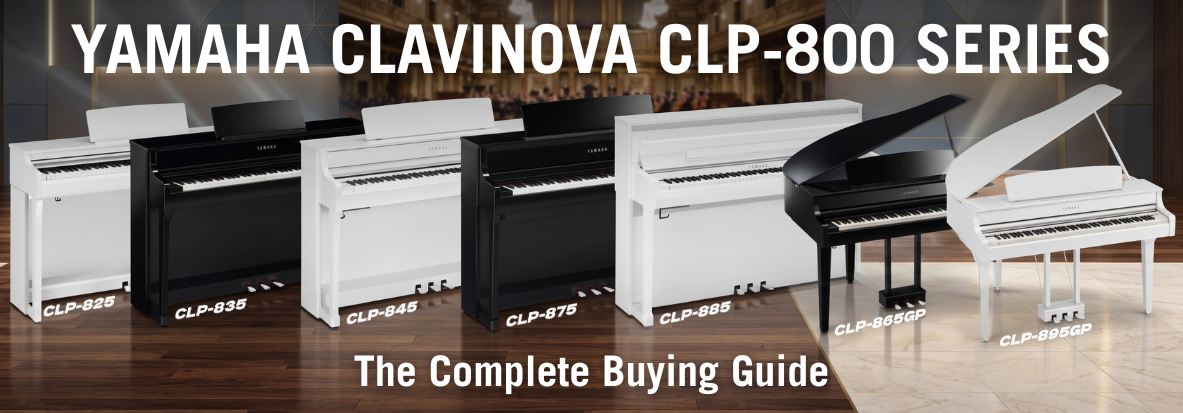
Seven pianos, one badge. Every model in Yamaha's CLP-800 Clavinova range from the CLP-825 to the CLP-895GP, carries the same two flagship piano voices, the same modelling technology, and the same promise of grand piano touch. What separates a piano that costs a few hundred pounds more from one that costs a few thousand more isn't always what people assume. Once you know where the real differences sit; the keyboard action, the cabinet, the speakers, choosing between them gets a lot easier.
This guide walks through the whole CLP-800 range, model by model, and answers the questions we hear most often in the showroom: which pianos have counterweighted keys, what Linear Graded Hammers actually feel like, whether the sound engine changes between tiers, how headphone practice compares across the range, and where the flagship CLP-885 sits next to Yamaha's hybrid AvantGrand NU1XA. It closes with exactly what happens after you order and how Yamaha Music London delivers and sets up your new piano.
| Model | Keyboard action | Counterweights & Linear Graded Hammers | Cabinet style | Speaker system |
|---|---|---|---|---|
| CLP-825 | GrandTouch-S | No | Upright, sliding key cover | Standard |
| CLP-835 | GrandTouch-S | No | Upright, sliding key cover | Standard |
| CLP-845 | GrandTouch-S (wooden white keys) | No | Upright, sliding key cover | 2-way with diffusers |
| CLP-865GP | GrandTouch-S | No | Grand piano-style cabinet — "performance essentially equivalent to the CLP-845" | 2-way with diffusers |
| CLP-875 | GrandTouch (wooden white keys) | Yes | Upright, sliding key cover | 3-way with Bidirectional Horns, diffusers, and Grand Acoustic Imaging |
| CLP-885 | GrandTouch (wooden white keys) | Yes | Upright, sliding key cover | 3-way with Bidirectional Horns, diffusers, and Grand Acoustic Imaging |
| CLP-895GP | GrandTouch (wooden white keys) | Yes | Grand piano-style cabinet, sliding key cover, "performance essentially equivalent to the CLP-885" | 3-way with Bidirectional Horns, diffusers, and Grand Acoustic Imaging |
Notice the pattern: Yamaha effectively builds two performance tiers and then offers each in two cabinet shapes. The CLP-845 and CLP-865GP share a performance level; one upright, one grand-shaped. The CLP-885 and CLP-895GP do the same at the flagship level. The CLP-825 and CLP-835 sit as the accessible entry point, upright only. Once you understand that structure, the rest of this guide is about which side of it suits you.
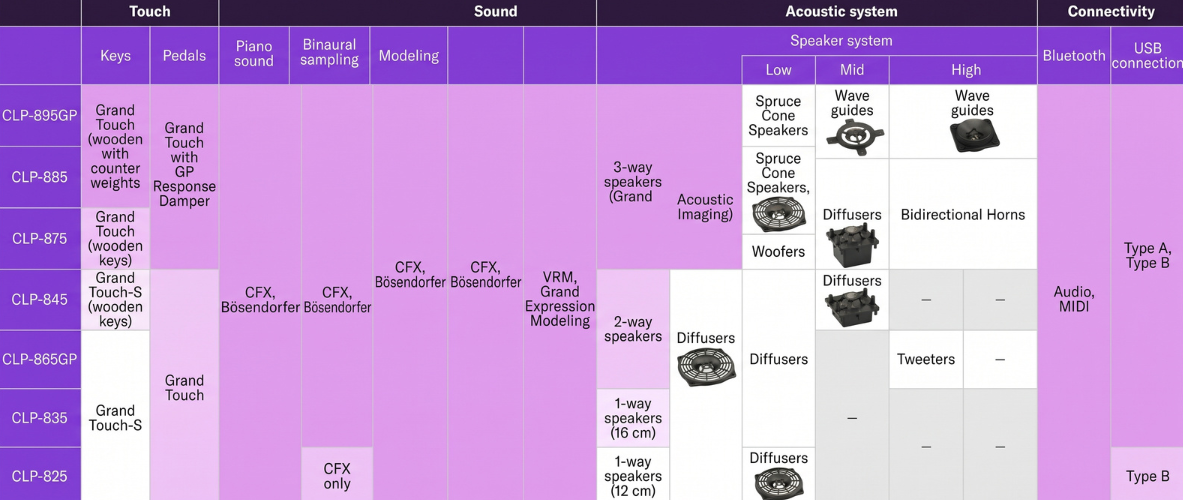
Only three models in the range have counterweighted keys and Yamaha's 88-key Linear Graded Hammers: the CLP-875, CLP-885, and CLP-895GP. These three use Yamaha's full GrandTouch keyboard action. The other four, the CLP-825, CLP-835, CLP-845, and CLP-865GP all use the GrandTouch-S action, which shares the same wooden-key construction and escapement mechanism but omits the counterweights and linear hammer grading.
Counterweights are small weights built into each key that balance the hammer assembly. Practically, that means more precise control when playing quietly, and keys that return to rest fast enough to keep up with rapid repeated notes. The kind of passage that catches out a lesser action. It's the difference a Grade 6+ or advancing player will feel first, and the reason the GrandTouch tier is positioned above GrandTouch-S rather than simply being the same action with a different name.
Yamaha describes its 88-key Linear Graded Hammer technology as providing "a distinct touch for each key with the same weight and return as the corresponding key on a grand piano." In plain terms: instead of grouping the keyboard into a handful of weighted zones (heavy in the bass, medium in the middle, light in the treble), every one of the 88 keys is individually weighted, so the transition from bass to treble is continuous rather than stepped.
Play a slow scale from the bottom of the keyboard to the top on a CLP-875, 885, or 895GP, and the weight should ease off key by key, the way it does on an acoustic grand — not in three or four noticeable jumps. Combined with the counterweighting described above, that's what Yamaha means by touch "approaching those of a grand piano": it's specifically about how gradually and predictably the resistance changes as you move across the keys, not just how heavy the keys feel overall.
Upright cabinets (CLP-825, 835, 845, 875, 885) all use a sliding key cover rather than a hinged, drop-down fallboard which is a slimmer, more contemporary upright silhouette. Height, depth, and weight increase as you move up the tiers (the CLP-885, for example, is noticeably larger and heavier than the CLP-825) to accommodate the larger speaker systems and cabinet resonance chamber of the higher models.
Grand piano-style cabinets (CLP-865GP, CLP-895GP) trade the upright footprint for an actual grand-piano-shaped case, for players who want the look of a grand in a room that can't accommodate an acoustic one. Yamaha positions these as sharing the identical internal performance of their upright siblings: the CLP-865GP is "essentially equivalent" to the CLP-845, and the CLP-895GP to the CLP-885. So the GP models aren't a different performance tier, they're a different piece of furniture around the same instrument, at a price premium for the cabinetry.
This is the one that surprises people: largely, no. Every model in the CLP-800 series from the entry CLP-825 to the flagship CLP-895GP is built around the same two premium piano voices, the Yamaha CFX (a modern Yamaha concert grand) and the Bösendorfer Imperial (the Viennese concert grand famous for its extended bass), captured with binaural sampling and reproduced through Virtual Resonance Modeling (VRM) and Grand Expression Modeling. Yamaha's own specifications confirm this sampling and modelling combination runs across the entire range, not just the top tier.
What genuinely changes as you move up the range is how that sound is projected into the room. The CLP-825 and CLP-835 use a standard speaker configuration; the CLP-845 and CLP-865GP step up to a 2-way system with diffusers; and the CLP-875, 885, and 895GP share Yamaha's top-tier 3-way system with Bidirectional Horns, diffusers, and Grand Acoustic Imaging technology, which Yamaha describes as reproducing the sound image and sound field of a real grand piano. So the underlying "brain" generating the piano sound is consistent throughout the series, so what you're paying more for at the top is a bigger, more sophisticated amplification and speaker system to carry that sound around the room, not a different sound engine.
This follows directly from the point above, and it's good news if your budget doesn't stretch to the flagship: because the same binaural sampling drives every CLP-800 model, headphone practice is designed to feel similarly immersive whether you're on a CLP-825 or a CLP-895GP. Yamaha's own description of the binaural technology is that it makes pianists "feel as though they are sitting at a grand piano even when they play with headphones on". A claim made about the technology itself, not reserved for the top-tier cabinets and their larger speaker systems.
In other words, the 3-way speakers, Bidirectional Horns, and Grand Acoustic Imaging on the CLP-875/885/895GP improve how the piano sounds out loud in your room, they don't meaningfully change what you hear through a pair of headphones during late-night or silent practice. If headphone practice is your primary use case (shared households, flats, late-evening practice), that's a real point in favour of the more affordable models in the range.
By Yamaha's own positioning, the CLP-895GP and CLP-885 sit at the top of the range, described as delivering "the best touch and sound in the series." Since the CLP-895GP's performance is built to be essentially equivalent to the CLP-885, choosing between them really comes down to cabinet shape and budget rather than capability; a grand-piano silhouette against a space-saving upright.
That flagship positioning has external backing, too: the CLP-885 was named Best Digital Piano of 2025 by MusicRadar, a recognition Yamaha itself has highlighted, praising the instrument for combining "charming good looks with fantastic playability," an authentic grand piano feel, and a "world-class sound engine" versatile enough for classical and jazz playing alike.
That said, "best" depends heavily on what you actually need. For an advancing student, teacher, or professional who wants the most refined touch and the fullest projected sound, the CLP-885/895GP earns that title. For a family working through the grades in a smaller room, the CLP-845 or CLP-865GP delivers the same core sound engine with a genuinely capable action at a more accessible entry point. There isn't a single "best" Clavinova so much as a best Clavinova for your stage of playing and your room.
This is a genuinely different question from "which CLP-800 model should I buy," because the NU1XA isn't a Clavinova at all, it belongs to Yamaha's AvantGrand hybrid piano range, a step beyond the CLP-800 series entirely.
The core difference is the keyboard action itself. The CLP-885's GrandTouch action is a purpose-engineered digital mechanism: wooden keys, counterweights, and Linear Graded Hammers built specifically to simulate a grand piano's response. The NU1XA takes a different approach. It uses a specialised upright piano action with genuine hammers, sensed by a non-contact electromagnetic detection system rather than triggering a note through a simple key-press switch. There are no strings and no soundboard, so it's still fundamentally a digital instrument for sound generation, but the mechanical part you actually touch is a real acoustic piano action, not an engineered approximation of one.
That authenticity comes with trade-offs: the NU1XA is significantly larger and heavier (around 108kg, versus roughly 87–90kg for the CLP-885) and sits above the entire CLP-800 range in price. Both instruments share the same CFX and Bösendorfer Imperial voices, the same Virtual Resonance Modeling, Grand Expression Modeling, and binaural sampling for headphone, so the sound technology underneath is common ground. The decision between them comes down to whether you want Yamaha's best simulation of a grand piano action in a Clavinova-sized instrument, or the genuine mechanical feel of an acoustic action in Yamaha's hybrid AvantGrand range, at a larger footprint and higher investment.
Once you've chosen your model, Yamaha Music London's Home Installation Service covers digital and hybrid pianos across the Clavinova, AvantGrand, and YDP ranges. The service delivers your new piano to the room of your choice (subject to suitability; additional charges can apply for stairs or difficult access, confirmed at checkout), unpacks and assembles it, powers it up to confirm everything is working correctly, and removes all the packaging on the way out. All they ask in return is a nearby mains socket.
For general orders, in-stock items are typically dispatched within 2–3 working days, with next-day delivery available on eligible items ordered before 2pm Monday to Thursday. Once your piano has arrived and been set up, it's worth registering it directly with Yamaha to activate your warranty. If a fault or a technical question comes up later, Yamaha Music London's Piano Tuning & Technical Service team is the next port of call. Though, notably, a digital Clavinova doesn't need the regular tuning an acoustic piano does, since there are no strings to go out of tune in the first place.