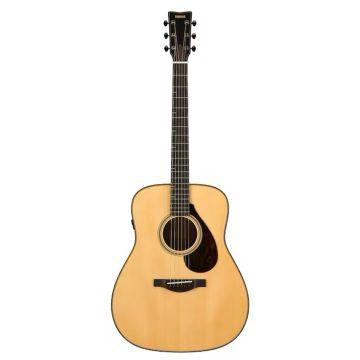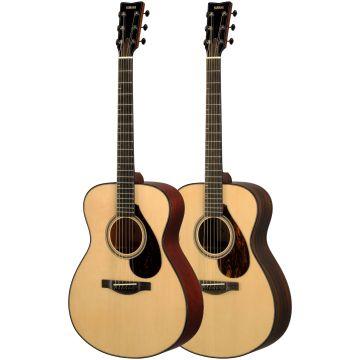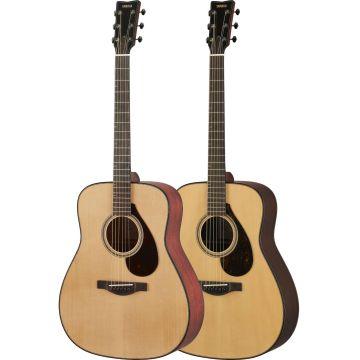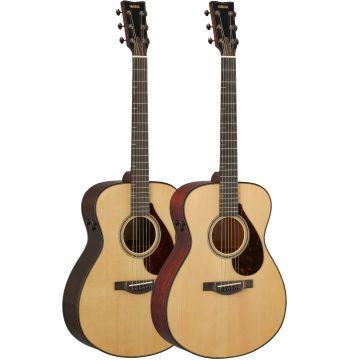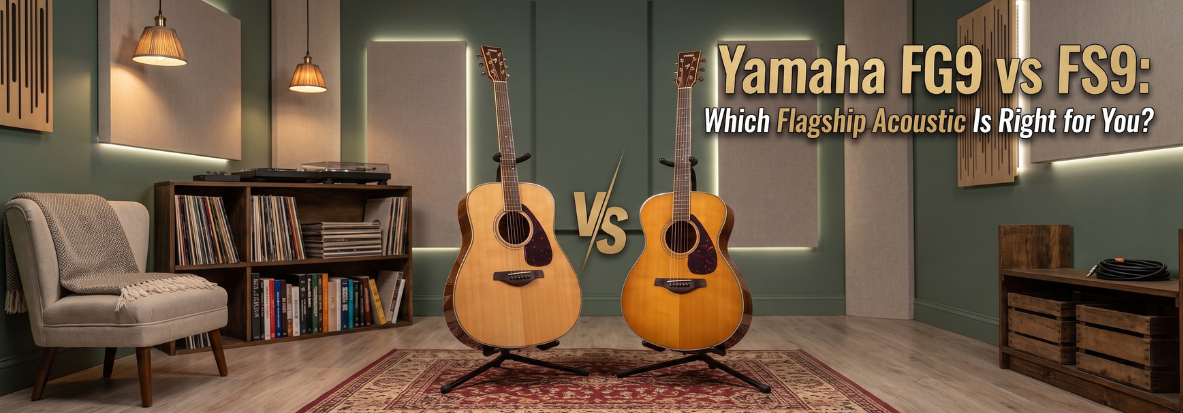
Yamaha's flagship FG9 and FS9 acoustic guitars share the same handcrafted Japanese construction and Adirondack spruce tops — but they're built around two different body shapes for two different playing styles. Here's how they compare, and how to work out which one is right for you.
The short answer: the FG9 is a dreadnought-style acoustic built for powerful strumming and vocal accompaniment, while the FS9 uses a smaller concert-style body designed for fingerpicking and detailed, subtle playing. Both are handcrafted in Japan from solid Adirondack spruce, mahogany or rosewood, and share the same neck, bracing and hardware specification. The choice comes down to body size and how you play.
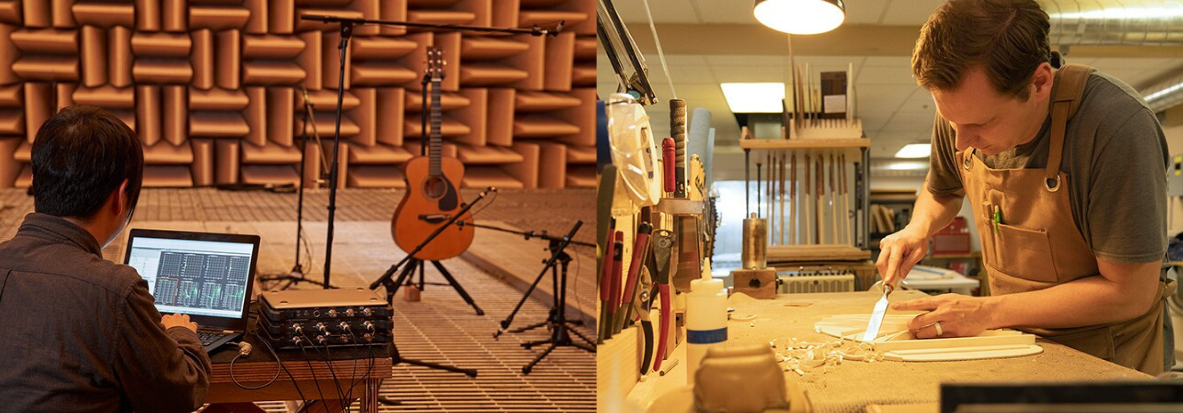
Before splitting the two ranges apart, it's worth being clear about what they share, because it's substantial. Both the FG9 and FS9 are handcrafted in Japan, they are not assembled from imported parts, but built at Yamaha's Japanese custom shop, where prototypes were developed using acoustic measurement and 3D structural analysis alongside traditional luthier techniques. Yamaha does build guitars in multiple countries across its wider range depending on the series and price point, but the FG9 and FS9, as flagship models, are Japanese-built throughout.
Both guitars use a solid Adirondack spruce top with tapered edges, sitting over scalloped X bracing, a bracing pattern designed to let the top vibrate more freely while keeping the structure strong. Every FG9 and FS9 is fully solid-wood: solid Adirondack spruce on top, with solid African mahogany or solid Indian rosewood back and sides depending on the finish. Both ranges use a bolt-on, one-piece mahogany neck with a rounded V profile, an ebony fingerboard and bridge, a bone nut and saddle, and Gotoh SXN510 tuners in Cosmo Black. Both come finished in nitrocellulose lacquer, with the Kumiki-inspired fingerboard inlays and rope-pattern rosette purfling that define the series' look, and both are supplied as standard with a hardshell case.
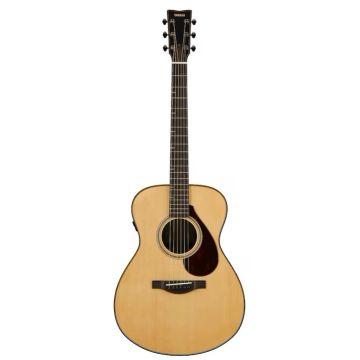
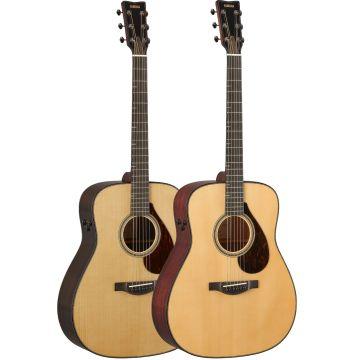
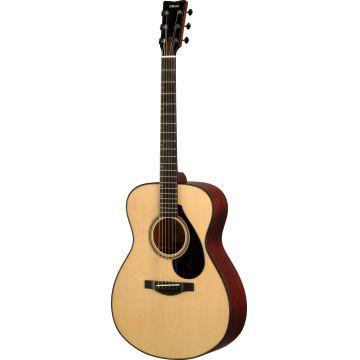
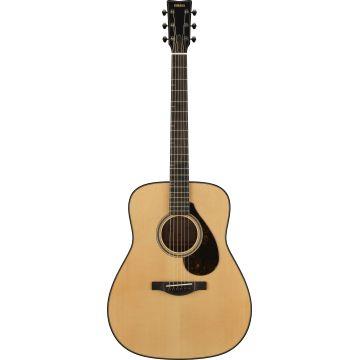
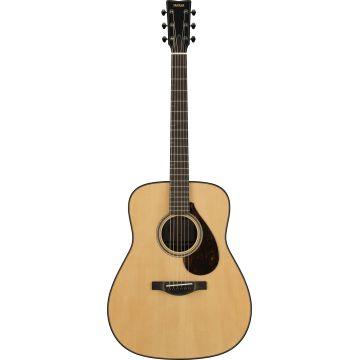
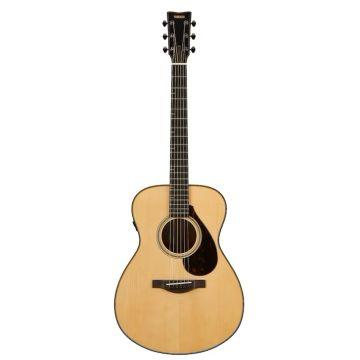
This is the core distinction between the two guitars, and Yamaha is direct about it: the dreadnought-style design of the FG9 is built for powerful strumming, while the FS9's compact, concert-style body is built for fingerpicking. It's a difference in size as well as character; the FG9's body is around 412mm wide and 100–125mm deep, while the FS9 is a smaller 380mm wide and 90–115mm deep, with a slightly shorter 634mm scale length against the FG9's 650mm.
The FG9's larger dreadnought body responds strongly to strumming, producing powerful lows and a projective, cutting tone. If you're mostly playing rhythm guitar, accompanying vocals with full chords, or want a guitar that can hold its own unamplified in a room with other instruments, the FG9's broader soundboard and higher air volume are built for exactly that.
The FS9's smaller concert body trades some raw low-end power for a more balanced, sensitive response. It is built to enhance subtle, detailed playing such as fingerpicked arpeggios, where the smaller box responds more evenly across the frequency range rather than favouring the bass. Yamaha also gave the FS9 a thicker back board than earlier FS-shaped models specifically to add more power to that smaller body, so it isn't simply a quieter FG9. It's a different tool for a different technique. Players who spend most of their time fingerpicking, or who find a dreadnought physically large to play seated, are the FS9's core audience.
Play them both, side by side: Specs and descriptions only tell you so much with instruments at this level, body shape and tonewood are genuinely felt in the hands. Both the FG9 and FS9 are on display in our Soho showroom, along with the full range of tonewood and X-series options, so you can compare strumming and fingerstyle response directly before deciding.
Both the FG9 and FS9 are available with either African mahogany or Indian rosewood back and sides, and this choice has as much influence on the guitar's voice as the body shape does. According to Yamaha's own specifications, the Mahogany (M) back and sides are built to achieve a warm and balanced sound; a tonal character that concentrates around a focused midrange. The Rosewood (R) back and sides are specified to emphasise crystal-clear highs, along with rich lows and harmonic overtones; a wider frequency spread, with more sparkle on top and more depth underneath than the midrange-forward mahogany.
In practical terms: if you want a punchy, direct, midrange-focused voice that sits forward in a mix or against a singing voice, mahogany is the traditional choice. If you want a more complex, shimmering tone with extended top and bottom end, rosewood is built to deliver that. Neither wood is objectively "warmer" than the other in isolation, they distribute warmth differently across the frequency range, so this is a genuinely personal choice, and one best made by ear.
Both the FG9 and FS9 use Adirondack (red) spruce rather than the Sitka spruce found on most production acoustic guitars, including Yamaha's own Red Label series. Adirondack spruce is a stiffer, denser tonewood, which generally gives it a higher dynamic ceiling: it can absorb harder strumming or picking before the tone compresses, translating into greater headroom, stronger projection, and a clearer top end under aggressive playing. Sitka spruce, by comparison, offers a more moderate, evenly balanced response that suits a wider range of playing styles at lower volumes. Yamaha's tapered-edge top construction, used across the FG9 and FS9, is designed to work with this stiffer wood to keep the soundboard responsive rather than overly stiff.
Both the FG9 and FS9 use a mahogany neck with a rounded (soft) V profile, a 44mm (1¾") nut width, and a bolt-on joint rather than the glued-in neck used on earlier FG and FS models. Yamaha specifies this profile as designed for enhanced comfort and smooth playability, and the bolt-on construction is intended to improve both body vibration and long-term maintainability: a bolted neck can be removed and reset more easily than a glued one if adjustment is ever needed. Neck feel is inherently subjective, and players who found earlier or lower-tier necks chunky may find this profile different in the hand; the only reliable way to judge it is to play one, which you're welcome to do in our Soho showroom.
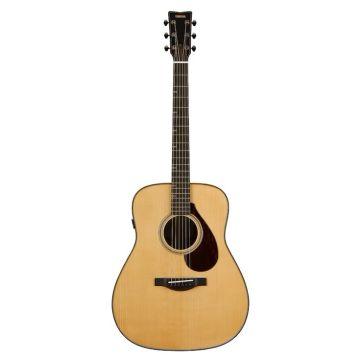
Yes, electro-acoustic versions of both guitars exist. The FG9 X and FS9 X series (offered as RX and MX rosewood/mahogany variants) are acoustically identical to the standard FG9 and FS9, but add Yamaha's Atmosfeel three-way pickup and preamp system. Atmosfeel combines a piezo sensor under the bridge to capture low frequencies, a built-in microphone for midrange and low-end character, and a thin synthetic soundboard transducer for the high end, blended through a single control set for a natural amplified tone. If you expect to play live or record regularly and want to avoid relying on a separate microphone, the X-series is worth considering; if the guitar will stay acoustic, the standard FG9 or FS9 keeps the build simpler and the price lower.
It's a common question in-store, and it's worth answering with the facts rather than a sales pitch. Yamaha's Red Label FG5 and FS5 models are also made in Japan; so country of manufacture isn't what separates the two tiers. The difference comes down to specification: the Red Label FG5/FS5 use a solid Sitka spruce top with solid mahogany back and sides and Acoustic Resonance Enhancement (A.R.E.) treatment, while the FG9/FS9 step up to a solid Adirondack spruce top with a choice of mahogany or rosewood, a bolt-on neck rather than glued, and Yamaha's flagship-tier fit, finish and hardware. Whether that upgrade translates into a meaningful playing or tonal improvement for you is something only your own ears and hands can answer. We'd always recommend comparing an FG5/FS5 against an FG9/FS9 directly rather than deciding on spec sheets alone.
Don't forget the accessories: Whichever model you choose, we stock the accessories to look after it — hardshell case humidifiers and humidity packs, D'Addario and Elixir string sets to match the factory-fitted strings, guitar straps, capos, and setup and restringing services from our in-store technicians.
The FG9 60th Anniversary Edition
Yamaha has also released a limited FG9 60th Anniversary Edition, marking 60 years since the original FG180 launched in 1966. It keeps the FG9's dreadnought body shape, bolt-on mahogany neck, scalloped X bracing and hardshell case, but pairs the Adirondack spruce top with Guatemalan rosewood back and sides and a thicker back board for added projection. It's made in Japan as part of a limited production run. At the time of writing, Yamaha has not announced an equivalent 60th Anniversary edition of the FS9.
| Specifications | FG9 | FS9 |
| Body shape | FG Dreadnought Style | FS Concert Style |
| Best suited to | Strumming, rhythm playing, vocal accompaniment | Fingerpicking, subtle and detailed playing |
| Scale length | 650mm (25 9/16") | 634mm (25") |
| Body width | 412mm (16 1/4") | 380mm (14 15/16") |
| Body depth | 100–125mm | 90–115mm |
| Top | Solid Adirondack Spruce | Solid Adirondack Spruce |
| Back & sides | Solid Mahogany (M) or Rosewood (R) | Solid Mahogany (M) or Rosewood (R) |
| Neck | Bolt-on Mahogany, rounded V profile | Bolt-on Mahogany, rounded V profile |
| Bracing | Scalloped X bracing | Scalloped X bracing |
| Electro-acoustic option | FG9 RX / MX (Atmosfeel) | FS9 RX / MX (Atmosfeel) |
| Case | Hardshell case included | Hardshell case included |
| Made in | Japan | Japan |