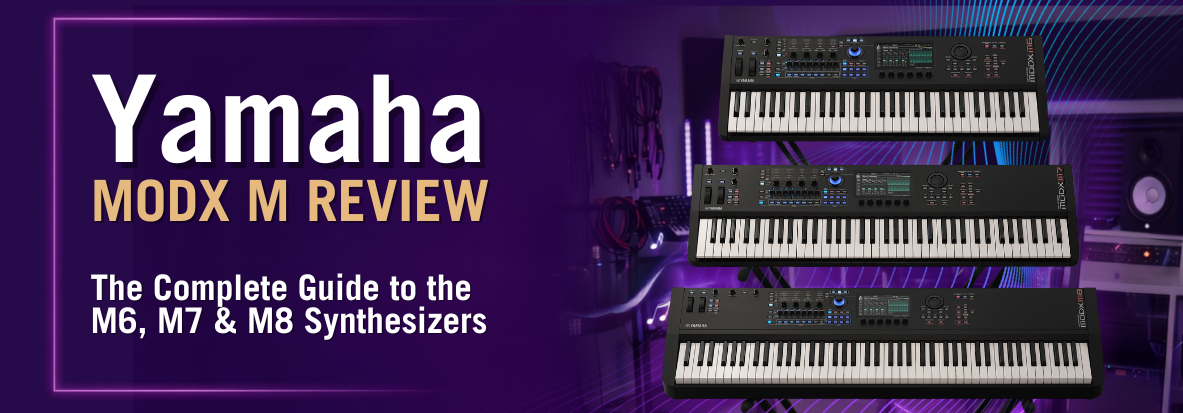
The Yamaha MODX M is a three-engine synthesizer workstation: AWM2, FM-X and the new AN-X virtual analogue engine which is built for stage and studio use. Launched in October 2025 as the successor to MODX+, it brings flagship MONTAGE M technology to a more affordable, portable instrument, available in three key-count options: the 61-key MODX M6, 76-key MODX M7, and 88-key MODX M8.
Whether you're a synthesist building complex sound design, a gigging keyboardist who needs a reliable stage workstation, or a pianist who wants a serious synth alongside a realistic weighted action, this guide answers the questions we hear most often in our Soho showroom: from live performance and sound layering to what actually makes the AN-X engine different.
Yes. MODX M is built with gigging musicians in mind. Eight physical faders (double the four found on the original MODX/MODX+) give instant control over Part levels, and dedicated Scene Select buttons let you switch Arpeggio on/off, Motion Sequences and Super Knob positions on the fly, without digging through menus mid-song. The Super Knob itself can control up to 128 parameters simultaneously; useful for building dramatic, hands-on transitions in a live set.
It's worth noting MODX M has no internal speakers (see below), so you'll need to run it into a mixer, PA, or powered monitors for performance. The instrument also includes a USB MIDI 2.0 and multichannel audio interface (10 out / 4 in), meaning a single USB cable can carry audio and MIDI to a laptop rig if you're performing with backing elements from a DAW.
The three-model range is built around three distinct player profiles:
Beyond these core profiles, MODX M also suits home studio producers who want hardware sound design without committing to the flagship MONTAGE M price point, worship and function-band musicians needing a do-everything keyboard, and anyone upgrading from an original MODX or MODX+ who wants access to the new AN-X analogue modelling engine.
Very closely; and that's by design. MODX M shares the same three core sound engines as the flagship MONTAGE M: AWM2 sample-based synthesis, FM-X frequency modulation, and the AN-X virtual analogue engine. It draws on the same waveform content and synthesis architecture, which is why reviewers have described it as bringing "flagship sound" to a mid-range price point.
The differences are mostly in scale and control rather than tone quality: MODX M offers 12 Insertion Effect slots (eight dedicated to Parts 1–8, four freely assignable across Parts 9–16), compared with Insertion effects across all 16 Parts on MONTAGE M. MONTAGE M also adds Pure Analog Circuit 2 output stage and balanced outputs, which give it a slight edge in headroom and analogue warmth through a proper studio monitoring chain. In everyday use, most players find the core sound engines indistinguishable between the two instruments.
No. Like its MODX and MODX+ predecessors, the MODX M range has no built-in speakers. You'll need to connect it to a mixer, audio interface, powered speakers, or headphones to hear it. Yamaha recommends connecting in stereo (most sounds and effects are programmed in stereo) via two standard 1/4" instrument cables into studio monitors or powered speakers, rather than a guitar or keyboard combo amp. One quirk worth knowing: the main L/R outputs stay live even when headphones are plugged in, so remember to turn down your speakers before switching to headphone monitoring.
Key action is one of the clearest differences across the range:
MODX M6 and MODX M7 use Yamaha's FSB semi-weighted synth action, an improved version of the keybed found on MODX+, designed for fast, expressive playing whether you're triggering synth patches or programming beats.
MODX M8 uses Yamaha's Graded Hammer Standard (GHS) action,a weighted, piano-style touch that gets heavier towards the low end, exactly as it would on an acoustic piano.
All three models support channel aftertouch, adding an extra layer of expression as you press further into a held note.
MODX M's effects are organised in three stages, giving you granular control without needing to patch anything manually:
Insertion Effects: applied at Part level, with two effect slots (A and B) per Part. There are 12 Insertion Effect slots in total: eight dedicated to Parts 1–8, and four that can be freely assigned across Parts 9–16.
System Effects: a shared Reverb (13 types, including Hall, Room, Plate and Shimmer) and Variation effect bus (88 types spanning delay, chorus, phaser, amp simulation, rotary speaker, wah, bit crusher and vocoder), each Part sending to them at its own level.
Master Effects: the final stage before output, offering 26 effect types (including VCM Compressor, Multiband Compressor and Lo-Fi) plus a five-band Master EQ for shaping the overall Performance.
This System/Insertion/Master structure is inherited directly from the MONTAGE and MODX architecture, so anyone upgrading from an earlier Yamaha workstation will find the workflow familiar.
ESP is a free virtual instrument plugin version of MODX M for use inside your DAW, available to all registered MODX M owners. It replicates the hardware's sound engine and lets you create, edit and mix Performances entirely in software, without needing the physical instrument connected, while also enabling seamless monitoring and synchronisation when it is connected. It's a strong addition for producers who want to keep working on MODX M sounds while travelling, or who want tighter integration between the hardware and a studio DAW session.
AN-X is MODX M's new virtual analogue synthesis engine, and the single biggest technical upgrade over the outgoing MODX+. It's built around three oscillators offering five waveforms (Saw1, Saw2, Square, Triangle and Sine), two filters with a choice of 10 filter types, pulse width modulation, oscillator self-sync, ring modulation, FM and wave-share routing. Voltage drift and aging settings recreate the subtle pitch instability of a real analogue circuit, giving patches an organic, vintage-style character. AN-X offers 12-note polyphony and sits alongside the sample-based AWM2 and FM-X engines, so a single Performance can layer all three engine types together.
The three MODX M models share identical sound engines, polyphony, memory and connectivity. The differences come down to key count, key action and target player, summarised below.
| MODX M6 | MODX M7 | MODX M8 | |
|---|---|---|---|
| Keys | 61-key semi-weighted (FSB) | 76-key semi-weighted (FSB) | 88-key graded hammer action (GHS) |
| Built for | Synthesists / sound designers | Working keyboardists | Pianists / producers |
| Sound Engines | AWM2, FM-X, AN-X | AWM2, FM-X, AN-X | AWM2, FM-X, AN-X |
| Total Polyphony | 268 notes | 268 notes | 268 notes |
| AWM2 Memory | 10.7GB preset / 1.9GB user flash | 10.7GB preset / 1.9GB user flash | 10.7GB preset / 1.9GB user flash |
| Display | Colour touchscreen | Colour touchscreen | Colour touchscreen |
| Controls | 8 faders, Super Knob, 6 display knobs | 8 faders, Super Knob, 6 display knobs | 8 faders, Super Knob, 6 display knobs |
| Connectivity | USB MIDI 2.0 + multichannel audio interface (10 out / 4 in) | USB MIDI 2.0 + multichannel audio interface (10 out / 4 in) | USB MIDI 2.0 + multichannel audio interface (10 out / 4 in) |
| Software | Free ESP plugin (registered owners, early 2026) | Free ESP plugin (registered owners, early 2026) | Free ESP plugin (registered owners, early 2026) |
Source: Yamaha UK / Yamaha Music London product pages, August 2026. All three models share identical sound engines, polyphony, memory and connectivity — the key differentiator across the range is the keybed and target player.
Yes. MODX M can play back WAV audio files loaded from a USB drive via its Play/Rec Audio feature, so you can bring in a backing track, click, or pre-recorded element and control it from the transport buttons alongside your live playing. Audio can also be loaded as a waveform assigned to a Part, letting you trigger a track from a single key and control its level with a fader, useful for triggering drum loops or backing stems mid-performance. For full-band or multitrack backing arrangements, MODX M's USB audio/MIDI interface also allows it to play back audio streamed directly from a laptop DAW, giving you more flexibility for complex live setups.
MODX M supports up to 128 Elements per Part in the AWM2 engine, giving enormous scope for layering samples, articulations and velocity switches within a single sound. At the Performance level, you can combine up to 16 Parts multi-timbrally layering acoustic instruments, synth pads, basses and FX sounds together, or splitting them across the keyboard. Eight of those Parts have dedicated Scene Selection buttons for instant live control, making it straightforward to build and recall complex, richly layered live sounds without losing hands-on access to the elements that matter most in performance.
A few accessories make a real difference to how MODX M performs day-to-day, whether it's living in a home studio or travelling to gigs. Yamaha produces a dedicated premium soft case for each mode SC-MODX M6 , SC-MODX M7 and SC-MODX M8 sized specifically to each keyboard, with padded protection, dedicated pockets for pedals and cables, and carry handles for transport between rehearsals and shows.
For players who want proper piano-style sustain, especially on the weighted MODX M8, the Yamaha FC3A footswitch supports half-damper control for continuously variable sustain, while the simpler FC4A footswitch covers standard on/off sustain and other assignable functions MODX M supports two footswitch inputs, so a sustain pedal and a second assignable pedal (for sostenuto, arpeggio hold, or Scene changes) can be used together. Add an expression pedal for real-time control over volume or assignable parameters during a performance, and a set of closed-back reference headphones, such as Yamaha's HPH-MT8 , for accurate silent practice and sound design.
Since MODX M has no internal speakers, a decent pair of powered studio monitors or a keyboard amp is effectively essential rather than optional. Our team in-store can help you match monitors to your room and playing style.
And for anyone planning to build out a DAW-based rig around MODX M, don't forget the free ESP plugin once registered, which extends the instrument's sound engine directly into your software setup at no extra cost.
Want to learn more about the MODXM, visit us in store, and speak to a member of our team today