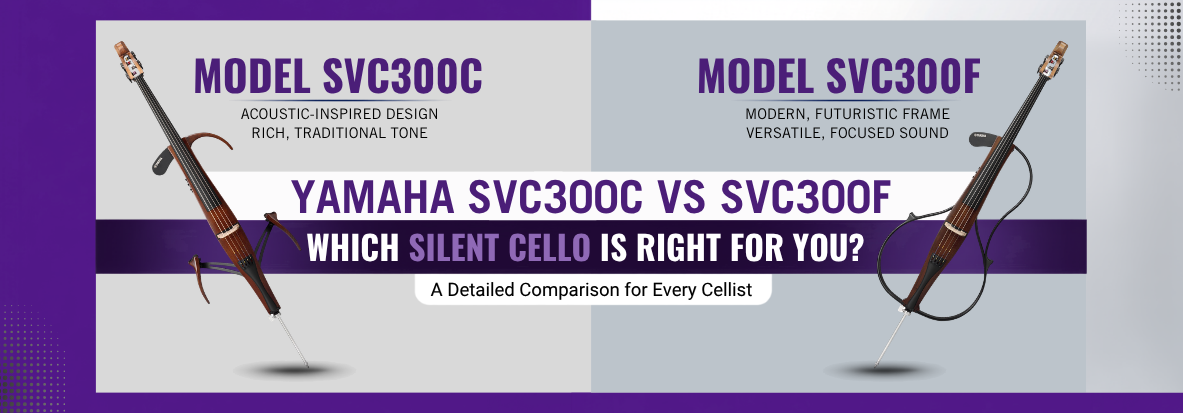
A factual, side-by-side guide to Yamaha's SILENT Cello SVC300 Series covering tone, frame, controls, portability and accessories from the team at Yamaha Music London.
The Yamaha SVC300C and SVC300F are the two models in Yamaha's SILENT Cello SVC300 Series, launched worldwide in September 2025 as Yamaha's first SILENT Cello redesign in 19 years. The SVC300C has a compact, foldable frame and an edgier tone that Yamaha describes as suited to rock and pop, while the SVC300F has a full, traditional frame and a warmer, more acoustic-like tone that Yamaha describes as suited to high-quality practice and recording. Both share the same SRT Powered System, onboard controls and included accessories.
What is the Yamaha SILENT Cello SVC300 Series?
The SVC300 Series is Yamaha's newest addition to its SILENT Cello line, announced in September 2025. It is the first major redesign of Yamaha's SILENT Cello in 19 years, and the first SILENT Cello to feature Yamaha's SRT Powered System. The Series comprises two models; the SVC300C and SVC300F, each with a distinct body design and tonal character.
Yamaha describes the SVC300 Series as its flagship SILENT Cello, combining the quiet practice benefits of earlier models with a more resonant, natural playing feel. Both models share the same underlying technology and control set; the difference between them comes down to body construction and the resulting tone.
Which older models do the SVC300C and SVC300F replace?
Yamaha's official UK website lists the previous top-of-range model, the SVC210, as discontinued. On Yamaha Music London's own website, the current SILENT Cello range comprises the entry-level SVC-50 alongside the new SVC300C and SVC300F. The SVC-110 and SVC-210 no longer appear in the live product listing.
In terms of body shape rather than replacement status, the SVC300C carries forward the compact, foldable form associated with the previous SVC210SK, while the SVC300F carries forward the fuller, more traditional outline associated with the previous SVC110SK. The SVC-50 remains Yamaha's entry-level SILENT Cello and sits below the SVC300 Series in the current range.
| Feature | SVC300C | SVC300F |
|---|---|---|
| Body style | Compact, foldable frame | Full, traditional cello-shaped frame |
| Tone character | Edgier, tighter tone — suited to rock/pop | Warmer, acoustic-like tone — suited to practice/recording |
| Related earlier body shape | SVC210SK | SVC110SK |
| Colour finishes | Antique Dark Brown, Pearl White | Antique Dark Brown, Pearl White |
| Weight (without chest support) | 3.6kg | 3.6kg |
| Dimensions (without chest support) | 1,251 x 438 x 243mm | 1,251 x 438 x 243mm |
| SRT Powered System | Yes | Yes |
| Onboard controls | Power, Volume, Phones, Sound/Tuner, Blend, Reverb, Treble, Bass | Power, Volume, Phones, Sound/Tuner, Blend, Reverb, Treble, Bass |
| Power supply | 2x AA (alkaline/NiMH) or adaptor (sold separately) | 2x AA (alkaline/NiMH) or adaptor (sold separately) |
| Included accessories | Chest support, soft case | Chest support, soft case |
The SVC300C folds down for transport, with folding legs and removable chest and arm supports that let it disassemble into its carrying case. The SVC300F keeps a fuller, more continuous outline closer to a traditional acoustic cello's silhouette. Both retain an internal cavity structure inherited from earlier SILENT Cello designs, which supports acoustic resonance despite neither model having a full soundbox.
For players used to the feel of an acoustic cello, the SVC300F's fuller frame keeps more of the familiar reference points; the shoulder, chest and knee contact points, in a shape closer to a conventional instrument. The SVC300C trades some of that continuous outline for a lighter, more compact structure designed to fold away.
According to Yamaha, the SVC300C produces an edgier tone with a tighter sound, and Yamaha specifically describes it as suited to rock or pop performance. The SVC300F produces a warmer, more acoustic-like tone, and Yamaha describes it as ideal for high-quality practice and recording; the context in which classical players most often work.
Because both models share the same SRT Powered System and control set, the tonal difference comes from the body construction itself rather than separate electronics. Yamaha states that the circuitry for each model has been tuned to bring out its own distinct tonal character.
Not sure which tone suits your playing? Our Soho showroom team can talk you through both models and let you compare them side by side before you buy. Be sure to check on the day before travelling to the store, to ensure we have both in stock that day.
The SRT (Studio Response Technology) Powered System is Yamaha's digital technology that adds natural tone and resonance to an instrument's signal in real time, based on analysis of how acoustic instruments actually sound, rather than relying on pre-recorded or sampled sounds. The SVC300 Series is the first Yamaha SILENT Cello to use it.
SRT is already used in Yamaha's electric violins and SILENT Basses. For the SVC300 Series, Yamaha states it has optimised the way SRT data is created and measured specifically for cello, with separate circuit tuning for the SVC300C and SVC300F so each model keeps its own tonal identity.
Both models share the same set of side-mounted controls: Power (On/Standby), Volume, Phones, a Sound/Tuner switch, Blend control, Reverb with Room and Hall settings, and separate Treble and Bass EQ. A sound-type switch also lets players choose between two onboard sound settings.
Both models weigh 3.6kg without the chest support and come with a soft case for transport. The SVC300C additionally has folding legs and removable chest and arm supports, letting it disassemble fully into its case for the most compact travel footprint. The SVC300F, with its fuller acoustic-style outline, also comes with a removable chest support and soft case, but retains more of its continuous body shape.
Both models share the same set of connections: a Line Out (6.3mm, standard quarter-inch jack) for amplifiers, PA systems, mixers or audio interfaces; a Phones output (3.5mm) for private, silent practice; and an Aux In (3.5mm) for playing along with backing tracks or a metronome.
Neither model uses a separate belt pack. Power comes from two AA batteries: alkaline or rechargeable NiMH, housed within the instrument itself, or from an optional AC power adaptor, sold separately. Battery life is approximately 7.5 hours on alkaline batteries and approximately 9.5 hours on NiMH batteries.
The controls for both models are side-mounted directly on the cello body, so there's nothing extra to wear or clip on while you play.
Each SVC300C and SVC300F ships with a chest support and a soft carrying case. Published specifications list a bow and power adaptor as sold separately.
At Yamaha Music London we stock the full range of accessories to go with your SVC300C or SVC300F including: bows, rosin, power adaptors, headphones, stands and cases — in our Soho showroom and online.
Because the SVC300C and SVC300F share the same electronics but differ in frame and tone, the clearest way to choose between them is to play both. Our Soho showroom, at 152-160 Wardour Street, has both models set up and ready to try, with staff on hand to talk through the differences and help you find the right fit for your playing.
Come and compare the SVC300C and SVC300F in person, or browse the full SILENT Cello range online. Be sure to contact us before travelling to the store, to ensure we have both on the day