Everything you need to know about Yamaha's flagship TransAcoustic guitars. How they sound with the effects off, how the built-in looper actually works, and which body shape suits the way you play.
The Yamaha TAG3C and TAS3C are the flagship models in Yamaha's second-generation TransAcoustic guitar range; acoustic guitars with reverb, chorus, delay and a built-in looper built directly into the body, so you get studio-style effects without plugging into anything. The TAG3C is the dreadnought-cutaway version; the TAS3C is the smaller concert-cutaway version.
A TransAcoustic guitar is a standard acoustic guitar with actuators fitted inside the body instead of a speaker. String vibrations are picked up, run through onboard effects processing, and sent back into the actuators, which vibrate the guitar's own top and body to radiate reverb, chorus and delay out through the soundhole all without an amp, a PA, or a single pedal. Yamaha first launched the concept in 2016, and the TAG3C and TAS3C represent the second, more capable generation of that idea, adding a proper looper and Bluetooth audio streaming on top of the original reverb-and-chorus formula.
It's a genuinely different approach to a standard electro-acoustic guitar, which only adds effects once the signal leaves the instrument through an amp or pedalboard. On a TransAcoustic guitar, the effect is part of the acoustic sound itself, audible the moment you strum, which is why players who've never encountered one tend to assume there's a hidden speaker somewhere inside.
Strip away the shared electronics and the decision comes down to body shape, and everything that follows from it including the tone, projection, and how the guitar feels in your lap.
| TAG3C | TAS3C | |
|---|---|---|
Body Shape | Dreadnought cutaway | Concert cutaway |
Top | Solid Sitka Spruce | Solid Sitka Spruce with A.R.E. treatment |
| Back and sides | Solid Mahogany | Solid Mahogany |
| Neck/ Fingerboard | Mahogany / Ebony | Mahogany / Ebony |
| Body depth | 100–125mm | 90–115mm |
| Body width | 412mm | 380mm |
| Approx weight | 2.8kg (6.17lb) | 2.7kg (5.59lb) |
| Finishes | Natural, Sand Burst | Natural, Sand Burst |
| Effects & Electronics | Reverb, chorus, delay, looper, Bluetooth, SYSTEM76 | Reverb, chorus, delay, looper, Bluetooth, SYSTEM76 |
| Best suited for | Strumming, Rhythm playing, Players who want maximum projection | Fingerstyle, Songwriting, Players who want a tighter, more even response |
.png)
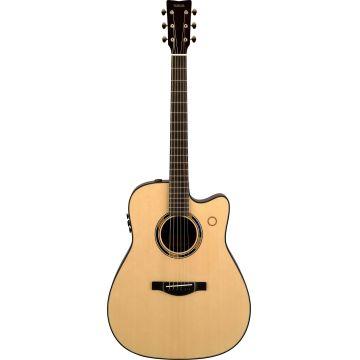
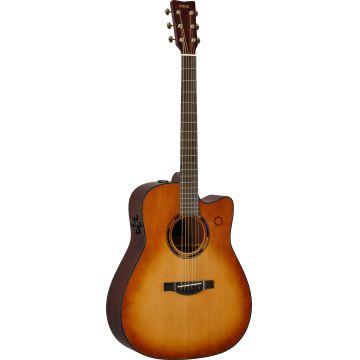
The TAG3C's dreadnought body is the larger, deeper-chambered shape, and it behaves like every well-built dreadnought before it: strong low-end, high volume ceiling, and the kind of projection that carries in a room without any amplification. It's the shape most associated with confident, full-handed strumming.
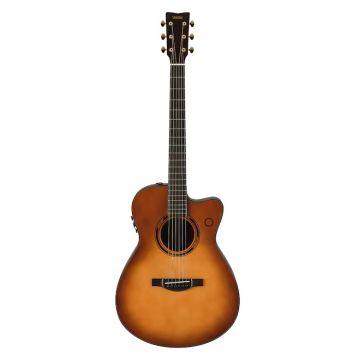
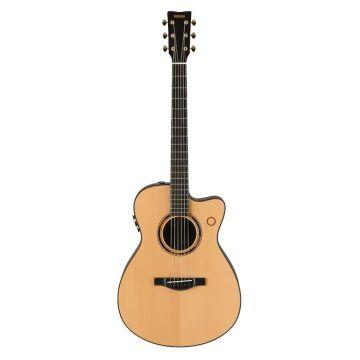
The TAS3C's smaller concert body trades some of that raw output for a tighter, more even response across the frequency range. It won't out-volume a dreadnought in a strumming contest, but it rewards fingerstyle and lighter playing with more clarity and separation between notes, exactly what you'd expect from a concert-sized instrument.
Both guitars are designed to stand on their own as acoustic instruments first. All-solid construction, solid Sitka spruce tops, solid mahogany back and sides, they're built to Yamaha's usual acoustic-guitar standard, with the actuators and control panel added afterwards rather than compromising the build to fit them in. If you never touched a single onboard effect, you'd still own a well-built, all-solid acoustic guitar worth its price on tone alone.
Both models use a body-tap interface instead of a floor pedal or footswitch. A circular sensor sits just below the soundhole. On the TAG3C it's marked out with a blue ripple inlay and a single tap arms the looper, a second tap ends the recording and drops it straight into playback. Tap it again to add another overdub on top. You can also arm and stop the looper from the reverb knob on the control panel if you'd rather not lean in to reach the soundhole.
How many layers can you loop? As many as you want. There's no fixed ceiling on the number of overdubs you can stack while you're actively playing, you can keep building a loop for as long as the idea holds up. Once you've got something you like, you can save and recall up to ten complete loops using the free TAG Remote app (iOS and Android), so your favourite ideas are ready the next time you pick the guitar up, even after it's been switched off in between.
For a hands-free interface, it's a genuinely quick thing to learn: tap to start, tap to stop, tap to overdub. There's no menu-diving and no separate hardware to carry, which is precisely the point. The whole appeal of a body-tap looper is that your hands never have to leave the strings.

The three effects are designed to work as a set rather than fight each other: chorus adds width and shimmer, delay adds rhythmic repeats, and reverb adds room ambience, and because they're all processed through the same onboard system before reaching the actuators, they layer cleanly rather than needing to be chosen one at a time. Effect levels and the line-out volume are controlled from four knobs on the top of the guitar's shoulder, with deeper parameter editing available through the TAG Remote app.
Because reverb, chorus and delay are applied by a single processing chain that everything passes through, rather than as separate tracks, the effects colour your live playing and any looped material equally. There's no way to loop a dry, effect-free layer underneath a heavily reverbed live part; whatever the onboard effects are set to they shape the whole sound coming out of the guitar at that moment, loop and live signal together. In practice, reviewers have found the separation between looped parts and live playing still comes through clearly, making it genuinely useful for building up multi-part ideas rather than just a novelty.
Instead of running the electronics off replaceable batteries, Yamaha built the TAG3C and TAS3C around a rechargeable lithium-ion battery good for up to 5.5 hours of use, charged through a magnetic connector on the guitar's upper shoulder rather than an exposed port. The supplied cable comes with interchangeable plug adaptors so the guitar can be charged from a standard wall socket almost anywhere in the world.
Bluetooth is used purely for audio streaming and app control, and not for the guitar's core effects processing, which runs locally. Pair a phone or tablet and you can stream backing tracks or your own music straight out of the guitar's soundhole, or open the TAG Remote app to fine-tune effect parameters and manage your saved loops.
Yes. Standard tuning, standard machine heads, standard strings, standard technique. The TransAcoustic system sits entirely on top of a normal instrument rather than replacing any part of how it's built or played. It's built for guitarists who want more creative tools, not a different instrument to learn.
The TAG3C and TAS3C are the second generation of Yamaha's TransAcoustic concept, and the upgrade over the original 2016-era models (the LL-TA, FG-TA, LS-TA and FS-TA) is substantial. Those first-generation guitars used a single actuator and offered two effects, reverb and chorus, with no looper, no Bluetooth, and standard replaceable batteries rather than a rechargeable system.
The TAG3C and TAS3C are engineered by Yamaha in Hamamatsu, Japan. Home to Yamaha's guitar design and R&D, and manufactured at Yamaha's own factory in China, rather than through a third-party contractor. Yamaha has operated wholly-owned production facilities outside Japan for decades across its instrument ranges, applying the same design specifications, tooling and quality-control processes at every site, so the country of manufacture reflects where in Yamaha's global operation the guitar is built, not a difference in oversight or quality standards.
If you're still deciding, the honest answer is that the electronics won't make the decision for you, they are identical. It comes down to the acoustic guitar underneath.
Whichever body shape you choose, a new TransAcoustic guitar deserves the right accessories around it. At Yamaha Music London we stock a full range of guitar accessories to keep it protected, in tune and ready to play, from stands and wall hangers to straps, cleaning and care products, plectrums , capos , spare strings and more.
Guitar Accessories
Stands & Wall Hangers
Guitar Straps
Acoustic Accessory Pack
Not sure what you need? The Acoustic Guitar Accessory Pack bundles a stand, strap, gig bag, capo, clip-on tuner and plectrums into one starter kit — an easy add-on at checkout.